

In this blog, we explore BLE Mesh technology, its architecture, benefits, and ideal applications in enterprise environments.
What Is BLE Mesh?
BLE Mesh is a networking protocol built on Bluetooth Low Energy (BLE), designed for many-to-many (m:m) communication. Unlike classic BLE, which relies on star topology, BLE Mesh creates a self-healing, decentralized network where devices (nodes) relay messages across the mesh.
This makes it ideal for large, distributed environments like smart buildings, industrial plants, and urban infrastructure.
Key Components of BLE Mesh
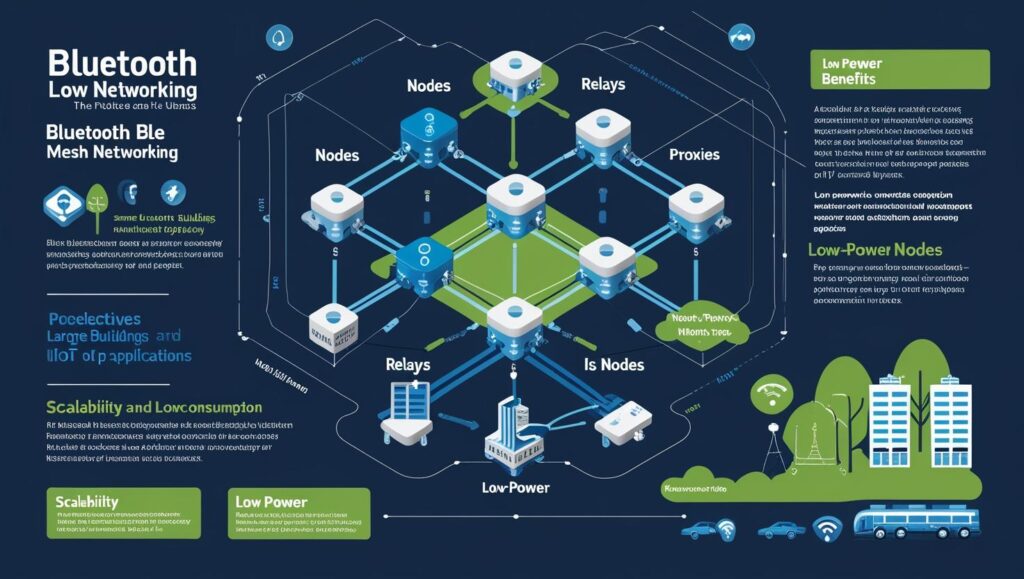
- Nodes: Devices that participate in the mesh network.
- Relays: Nodes that forward messages to extend network range.
- Proxies: Bridge nodes that enable communication between BLE Mesh and standard BLE devices.
- Friends & Low Power Nodes: Optimized for battery-saving use cases, especially in IoT sensors.
Advantages of BLE Mesh in Large-Scale Deployments
✅ Scalability
BLE Mesh supports thousands of devices, making it suitable for smart cities, hospitals, factories, and commercial buildings.
✅ Low Power Consumption
Devices can operate on coin-cell batteries for months or even years, reducing maintenance costs.
✅ Reliability
With multi-path communication and message relaying, the network can self-heal if one node fails.
✅ Security
End-to-end encryption, replay protection, and authentication are built into the BLE Mesh standard.
Ideal Use Cases
| Industry | Application |
|---|---|
| Smart Buildings | Lighting, HVAC, access control |
| Industrial Automation | Equipment monitoring, predictive alerts |
| Healthcare | Asset tracking, patient monitoring |
| Retail & Warehousing | Inventory management, smart shelving |
| Smart Cities | Street lighting, parking sensors, signage |
Real-World Example
Imagine a 100-floor commercial building with thousands of smart lights, sensors, and access points. BLE Mesh allows all devices to communicate, coordinate, and be controlled remotely and reliably, without the need for expensive wiring or centralized systems.
Why Choose Webyug Infonet LLP?
Webyug Infonet LLP, we specialize in BLE Mesh network design, integration, and deployment for enterprises and public infrastructure projects. Whether it’s automating a warehouse or creating a connected city grid, we help clients leverage BLE Mesh to maximize ROI and minimize complexity.
Our team handles:
- Network planning and simulation
- Hardware sourcing and custom firmware
- App and backend development
- Ongoing support and scalability management
👉 Partner with Webyug Infonet LLP to future-proof your connected infrastructure.
Frequently Asked Questions
Yes. It can support applications such as sensor communication, environmental monitoring, and selected automation tasks. Industrial deployments should validate latency, reliability, interference tolerance, and operational safety requirements before implementation.
BLE Mesh is suitable for low-power communication between many connected devices, such as smart lights and sensors. Wi-Fi is generally better for applications requiring higher data throughput, such as video streaming and large data transfers. The best choice depends on power requirements, coverage, bandwidth, and network design.
How Webyug Can Help
Webyug Infonet LLP provides digital development solutions that can support businesses exploring connected devices and intelligent applications.
- Bluetooth Beacon Solution — iBeacon & Eddystone deployments with GDPR-compliant encrypted ads
- Custom IoT Solution — End-to-end BLE 5.4, mesh, and LE Audio integrations
Conclusion
BLE Mesh networks offer a powerful, flexible solution for managing vast device ecosystems in real time. Their resilience, efficiency, and scalability make them an ideal choice for large-scale IoT and automation projects.
Looking to deploy BLE Mesh in your organization? Contact Webyug be your trusted technology partner.