

Bluetooth Low Energy (BLE) is a key technology powering modern wearable devices, including smartwatches, fitness trackers, smart rings, wireless health monitors, and smart hearing aids. Designed for energy-efficient wireless communication, BLE enables wearable devices to transmit data while minimizing power consumption.
As wearable technology becomes more advanced, manufacturers need reliable wireless connectivity without frequent charging. Bluetooth Low Energy helps extend battery life by reducing communication overhead, optimizing connection intervals, and enabling efficient data transmission.
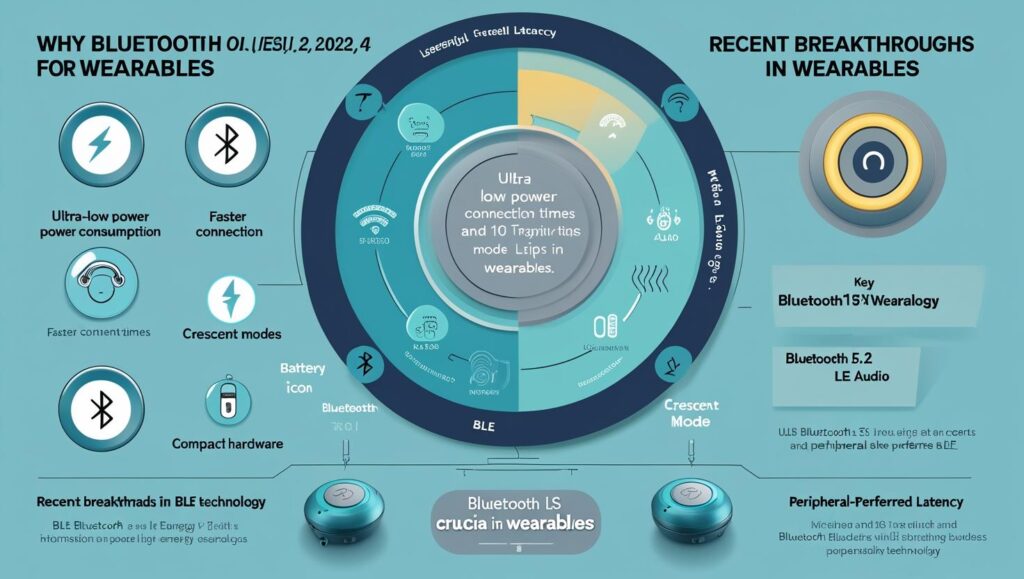
Why BLE is Crucial for Wearables? BLE is designed specifically for devices that operate intermittently, sending short bursts of data. Unlike classic Bluetooth, BLE consumes significantly less power, making it ideal for wearables that prioritize battery longevity.
Key benefits include:
- Ultra-low power consumption
- Faster connection times
- Optimized sleep modes
- Support for compact hardware
These features collectively contribute to extending battery life, allowing devices to function for days—or even weeks—on a single charge.
How Does BLE Improve Battery Life in Wearables?
BLE extends battery life through a combination of wireless protocol efficiency, device configuration, and firmware optimization.
1. Optimized Connection Intervals
BLE devices can adjust their connection intervals based on application requirements. A fitness tracker that synchronizes activity data periodically may not need the same communication frequency as a wearable health monitor that requires frequent updates.
Choosing appropriate connection intervals helps balance responsiveness and power consumption.
2. Low-Power Sleep Modes
Wearable devices can spend much of their time in low-power states when sensing, processing, or transmitting data is unnecessary. BLE-enabled microcontrollers can reduce radio activity and wake when communication or sensor processing is required.
This approach is especially valuable for smart rings, activity trackers, and compact medical monitoring devices.
3. Efficient Data Transmission
Instead of transmitting every sensor reading immediately, a wearable can buffer selected readings and send them in batches when appropriate.
For example, a fitness tracker may collect activity measurements throughout the day and synchronize summarized information with a smartphone periodically. This reduces unnecessary radio activity while preserving useful information.
4. Energy-Efficient Hardware
Modern BLE system-on-chips (SoCs) combine wireless connectivity, processing capabilities, and power-management features in compact hardware. Developers can select components based on radio performance, processing requirements, standby consumption, and battery capacity.
Efficient hardware design can reduce the overall energy requirements of wearable devices.
Recent BLE Advancements for Wearable Technology
1. Bluetooth 5.2 and LE Audio
Bluetooth 5.2 introduced important capabilities for Bluetooth LE, including Isochronous Channels, which support the architecture used by LE Audio.
LE Audio enables compatible devices to transmit audio over Bluetooth Low Energy and introduces features such as the Low Complexity Communication Codec (LC3) and support for Auracast broadcast audio.
These capabilities are particularly relevant to wireless earbuds, hearing aids, and assistive listening devices. Actual battery improvements depend on the device, implementation, audio configuration, and usage conditions.
2. Adaptive Connection and Latency Management
BLE connection parameters can be configured to meet different performance requirements. Devices can use shorter intervals when rapid updates are important and longer intervals when immediate responsiveness is less critical.
Peripheral devices may also request preferred connection parameters, subject to the central device's decision and Bluetooth specifications.
For wearable developers, this flexibility helps balance communication latency, reliability, and energy consumption.
3. Advanced Low-Power SoCs
BLE-enabled SoCs increasingly integrate radio transceivers, microcontrollers, memory, and power-management capabilities.
Selecting the right SoC can help manufacturers optimize:
- Radio transmission and reception energy.
- Standby and sleep-state consumption.
- Sensor-processing workloads.
- Wireless range and connection reliability.
- Overall device size and battery requirements.
The best choice depends on the wearable's workload, sensor configuration, and connectivity needs.
4. Smarter Firmware and Data Management
Firmware optimization plays an important role in reducing BLE power consumption. Developers can combine local processing, event-driven communication, sensor sampling strategies, and data buffering to minimize unnecessary transmissions.
For example, a wearable can transmit a notification when a meaningful threshold is reached instead of repeatedly sending unchanged readings.
However, safety-critical health monitoring must preserve the sampling frequency, alert timing, and data reliability required by the application.
BLE Use Cases in Wearable Devices
Health Monitoring Wearables
Wearable ECG monitors, glucose monitoring systems, and other connected health devices can use BLE to transfer measurements and alerts to compatible smartphones or receivers.
Power optimization must be balanced with monitoring continuity, data accuracy, and timely delivery of critical information.
Fitness Trackers and Smart Bands
Fitness trackers use BLE to synchronize step counts, sleep summaries, activity measurements, and other information with companion applications.
Periodic synchronization and local data processing can reduce unnecessary wireless communication.
Smartwatches
Smartwatches use BLE for notifications, application data exchange, and communication with paired devices. Carefully configured communication and power-management strategies help reduce battery drain while maintaining a responsive user experience.
Smart Rings
Smart rings have limited physical space for batteries and electronic components. BLE enables them to exchange biometric measurements and activity data with companion devices while supporting compact product designs.
Smart Hearing Aids and Wireless Audio Devices
BLE and LE Audio capabilities support compatible hearing aids and wireless audio products. Efficient audio transmission and power management are important because these devices may need to operate for extended periods each day.
Best Practices for Optimizing BLE Battery Life
Developers building BLE-powered wearable devices can improve energy efficiency by following these practices:
- Choose suitable connection parameters: Configure connection intervals and latency according to application requirements.
- Reduce unnecessary advertising: Adjust advertising intervals and durations to balance discoverability and energy use.
- Use notifications efficiently: Send updates when required rather than relying on unnecessary polling.
- Optimize sensor sampling: Collect data at a frequency appropriate for the intended use case.
- Process data locally: Filter or summarize information on the device when practical.
Battery life depends on more than BLE alone. Display brightness, sensor activity, processor workloads, battery capacity, radio conditions, and software design can all significantly affect how long a wearable operates between charges.
The Future of BLE in Wearable Technology
As wearable devices become smaller and more sophisticated, energy-efficient wireless communication will remain essential. BLE provides a flexible foundation for connected health monitoring, fitness tracking, smart accessories, and emerging IoT applications.
Future improvements in chip design, firmware optimization, sensor processing, and wireless protocol implementation can help manufacturers develop wearable products that offer reliable connectivity and better energy efficiency.
Frequently Asked Questions
How Webyug Can Help
Webyug Infonet LLP helps businesses develop connected solutions through IoT development, embedded firmware, BLE integration, and cloud connectivity. Our development services can help organizations design wearable and IoT products with a focus on energy efficiency, reliable communication, and scalable performance.
- Bluetooth Beacon Solution — iBeacon & Eddystone deployments with GDPR-compliant encrypted ads
- Asset Tracking Solution — Real-time AoA & RSSI fingerprinting for sub-meter accuracy
- Custom IoT Solution — End-to-end BLE 5.4, mesh, and LE Audio integrations
Conclusion:
BLE continues to evolve, pushing the boundaries of energy-efficient wireless communication. As wearable devices become more advanced, battery life remains a core concern—and BLE is at the forefront of addressing this challenge. Bluetooth Low Energy is a foundational technology for extending battery life in wearable devices. Its low-power communication capabilities, configurable connection parameters, efficient data exchange, and support for compact hardware make it suitable for a wide range of connected products.
Webyug Infonet LLP is pioneering smart, low-power wearable solutions powered by BLE. From device firmware to cloud integration, we deliver end-to-end development services that maximize battery life and performance.