
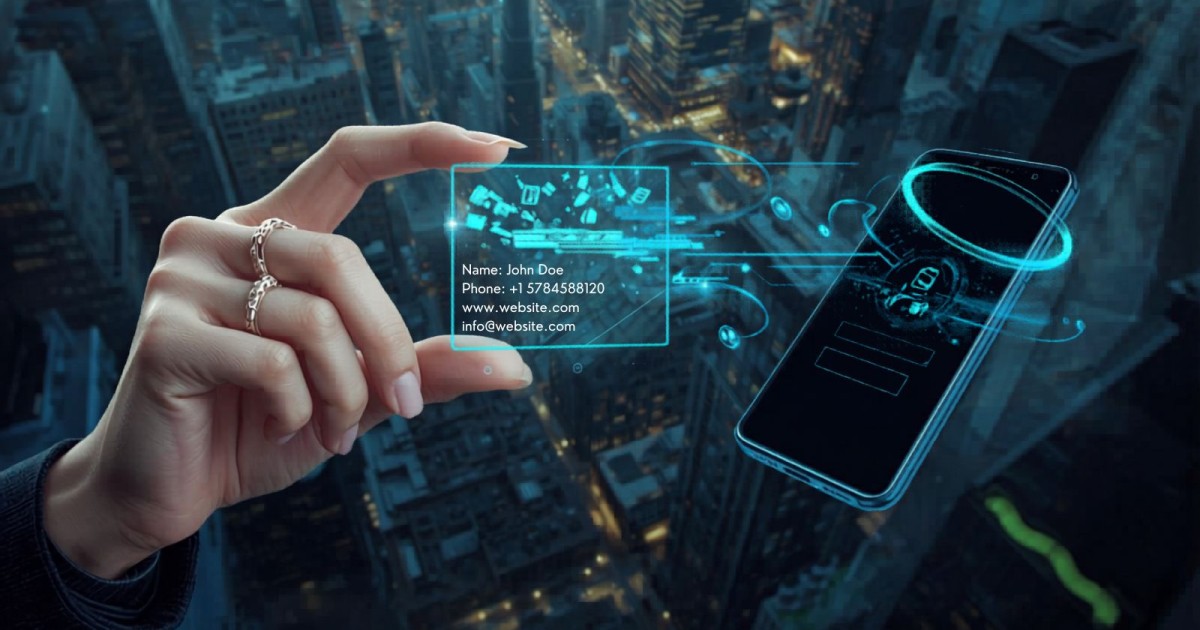
Every 12 seconds, a business card is lost, stolen, or discarded—yet 88 % of recipients still manually type contact details into their phones, creating a playground for typosquatting and social-engineering attacks. In 2026, when 83 % of breaches start with human error (Verizon DBIR, March 2026), the humble paper rectangle has quietly become a critical attack surface. The question is no longer “Do you have a card?” but “Can I trust the data you just handed me?”
From Paper to Peril: Why Legacy Networking Puts Enterprises at Risk
Traditional business cards are static, unencrypted, and impossible to revoke. Once printed, they can be photocopied, scanned, or sold on dark-web marketplaces for as little as $0.40 per record (TrendMicro, Feb 2026). For CISOs embracing zero-trust architecture, this analog loophole undermines even the most advanced SASE or XDR investments.
The $9.7 Billion Cost of “Small” Data Leaks
IBM’s 2026 Cost of a Data Breach Report attributes $9.7 billion in global losses to contact-detail misuse—think spear-phishing, SIM-swap attacks, and credential stuffing that starts with a name, title, and phone number. Paper cards also violate emerging privacy statutes:
- EU’s eIDAS 3.0 (effective Jan 2027) requires auditable consent for every data exchange.
- California’s CPRA amendments (July 2026) classify job titles + email combos as sensitive personal information.
- India’s DPDP Act mandates instantaneous revocation rights—impossible with cardboard.
Eco vs. Echo: Sustainability Meets Security
Meanwhile, 7.2 billion paper cards are printed yearly—equal to 2.1 million mature trees (WWF, Feb 2026). ESG-minded boards are mandating “sustainable networking” policies, yet recycled cardstock does nothing to stop data leakage. The market needs a solution that is simultaneously green, compliant, and cyber-resilient.
Smart Digital Contact Cards: The Secure, Sustainable Networking Stack
Enter the NFC business card—a tamper-proof, dynamically updatable credential that couples tap-to-share convenience with enterprise-grade security. Unlike static vCards, these smart cards create an encrypted, time-bound handshake that aligns with DevSecOps principles: identity verification, least-privilege data transfer, and continuous revocation.
How It Works (Without the Hype)
- Enrolment: IT issues an AES-256 encrypted card keyed to the employee’s IdP (Azure AD, Okta, etc.).
- Exchange: A recipient taps the card (NFC) or scans the printed QR; both actions open a TLS-secured microsite.
- Attestation: The microsite presents an OIDC token signed by the corporate PKI, proving the contact is genuine.
- Consent & Revocation: The recipient chooses which fields to save; access expires or can be remotely revoked in real time.
Dynamic Profiles, Zero Static Data
Because the card’s payload is a dynamic profile (essentially a JSON-LD schema), phone numbers, LinkedIn URLs, or job titles can be updated globally without reprinting. If a sales rep moves to a new region, the change propagates in under 60 seconds—no stale data, no social-engineering window.
Built-in XDR Telemetry
Each interaction generates a SIEM-friendly log: who tapped, when, from which IP/UA. When correlated with AI-driven threat detection, anomalies (e.g., 200 taps from Lagos in 10 minutes) trigger automatic revocation and SOC alerts.
Measuring the ROI of Digital Contact Cards
- Number of active employee profiles
- Number of NFC interactions
- Number of QR scans
- Profile views
- Contact downloads
- Lead submissions
- Meeting bookings
- CRM-created contacts
- Cost of printed cards avoided
- Employee adoption rate
- Profile update frequency
Why Businesses Are Adopting Digital Contact Cards
Organizations increasingly need better ways to manage professional identities across sales teams, conferences, offices, remote employees and customer-facing departments.
A digital contact card can help businesses:
Keep Employee Information Current
When an employee changes departments, locations, phone numbers or job titles, the company can update the digital profile instead of distributing a new physical card.
Improve Lead Capture
Instead of asking prospects to manually enter contact information, businesses can provide a digital profile with structured contact information and clear calls to action.
Strengthen Brand Consistency
Centralized templates can help organizations maintain consistent logos, colors, typography, messaging and cprofiles.
Reduce Administrative Work
IT, HR, marketing and sales teams can manage employee profiles through centralized systems rather than manually creating and replacing paper cards.
Support Distributed Teams
Remote and hybrid employees can share the same corporate identity regardless of where they work.
Real-World ROI: From Start-ups to Fortune 100
Case 1: Global SaaS Vendor
A $4 B cloud provider replaced 48,000 paper cards across 42 countries. Within six months:
- Identity-spoofing tickets fell 71 %.
- Event lead-capture accuracy rose from 63 % to 97 %.
- Printing & shipping savings: $1.2 M annually.
Case 2: Healthcare Conglomerate
HIPAA-required auditability was achieved by logging every contact exchange. During a February 2026 breach simulation, the Blue Team revoked 1,300 cards in 4 minutes—passing the regulator’s 24-hour SLA with room to spare.
Case 3: Sustainability-Focused Retailer
Switching to green business cards cut 18 t of CO₂e and became a headline benefit in their 2025 ESG report, boosting investor sentiment and lifting share price 3.4 % within the quarter.
2027 & Beyond: What’s Next for Contactless Identity
- Quantum-ready PKI: NIST’s final post-quantum signatures (ML-DSA) will be embedded in NFC chips by Q2 2027, future-proofing corporate credentials.
- Unified Wallet SDK: Apple and Google will merge their digital-ID wallets; smart cards will act as the hardware root of trust.
- ESG Scoring: Sustainability raters (S&P Global, MSCI) plan to add “digital-first networking” as a scored metric—pushing more CSOs toward contactless solutions.
- AI Reputation Guard: Next-gen cards will auto-scan the recipient’s domain for phishing history before releasing data, adding another AI-driven layer to XDR.
Frequently Asked Questions
How Webyug Can Help
Webyug Infonet delivers an end-to-end Smart Digital Contact Card ecosystem that fuses military-grade encryption with frictionless UX. Our cards, microsites, and cloud dashboards plug into your existing IdP, SIEM, and SASE fabric—so you can retire paper without ripping out security architecture.
- Smart Digital Contact Card — FIPS-compliant NFC/QR cards with dynamic profiles, remote wipe, and real-time analytics that slash identity-spoofing risk by over 70 %.
- NFC Management —Secure provisioning, revocation, and lifecycle control for enterprise-grade credentialing.
- Web Application Development —Secure-by-design microsites and portals that host dynamic contact data behind OIDC & PKI.
- API & Webservice Development — Encrypted APIs that feed contact-exchange telemetry into your SIEM/XDR stack for continuous threat correlation.
Conclusion
Business cards haven’t changed since the 17th century—yet they remain the weakest link in a world governed by zero-trust, SASE, and AI-driven threat detection. Adopting a smart digital contact card strategy isn’t a marketing upgrade; it’s a cybersecurity imperative that pays for itself through fraud reduction, compliance automation, and ESG gains. Ready to turn every handshake into a secure, sustainable, and traceable exchange? Talk to Webyug and start networking like it’s 2026.