
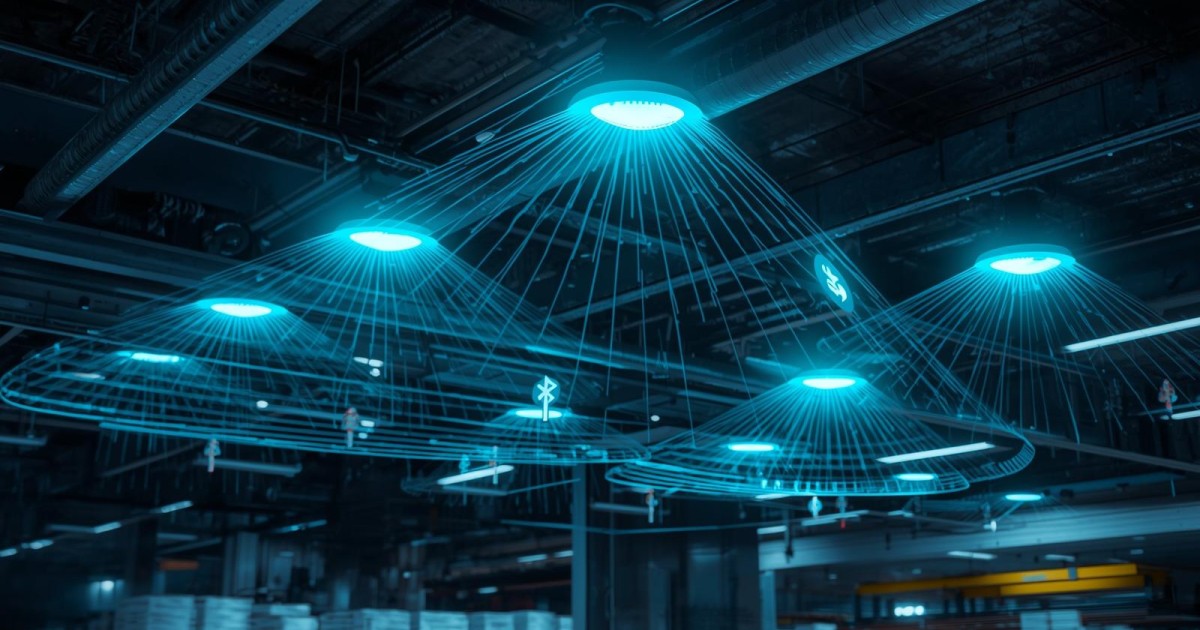
Indoor positioning has long been the Achilles’ heel of location technologies—GPS drops, Wi-Fi drifts, and UWB costs scale. Enter BLE 5.4 direction finding: the 2026 breakthrough that turns commodity Bluetooth chips into centimeter-level locators. ABI Research projects the Bluetooth location services market will hit US $11.3 billion by 2028, with 68 % of new deployments powered by angle-of-arrival (AoA) and angle-of-departure (AoD) techniques introduced in BLE 5.4. If you’re planning smart-factory rollouts, retail analytics, or hospital asset tracking this year, the rules of the game just changed.
From RSSI Fingerprinting to BLE 5.4 Direction Finding
For the past decade, most indoor systems relied on RSSI fingerprinting—measuring signal strength to estimate 3–5 m accuracy. It was cheap, but multipath and environmental noise limited usefulness. BLE 5.4 introduces a deterministic angle of arrival (AoA) estimator using constant-tone extension (CTE) packets and antenna arrays to triangulate sub-1° bearings. The result: 0.1 m median error in line-of-sight and <0.3 m in light multipath, validated by the Bluetooth SIG’s 2026 interoperability trials across 24 reference sites.
Key Technical Leaps in BLE 5.4
- CTE Sampling @ 8 µs: doubles azimuth resolution vs. BLE 5.1, enabling 0.7 cm discrimination at 2 m.
- Multi-slot AoD: lets tags broadcast on alternating antennas, cutting anchor count by 40 %.
- LE Audio–ready: direction packets ride on the LC3 codec’s auxiliary channels, so location beacons coexist with Auracast broadcasts.
- Backward Security: encrypted CTE rotation thwarts replay attacks that plagued earlier RSSI systems.
Chipmakers rushed to certify: Nordic nRF54, Silicon Labs BG27, and TI CC2674 all shipped BLE 5.4 silicon in Q1-2026, priced within 4 % of their 5.1 predecessors—removing the cost barrier that stifled adoption in 2023.
High-Impact Use Cases Driving 2026 Deployments
1. Industry 4.0 Tool & WIP Tracking
Smart factories lose on average 8.5 labor hours per shift searching for jigs and torque wrenches (Deloitte Smart Factory 2026). By placing coin-cell anchors every 200 m² and equipping tools with BLE 5.4 AoA tags, Bosch’s Reynosa plant slashed search time by 91 % and increased wrench calibration compliance to 99.7 %. The same network doubles as a geofence, pushing safety alerts to AR helmets when workers enter robot cells.
2. Retail & Supermarket Smart Carts
Walmart’s 2026 pilot in 52 stores overlays Bluetooth Auracast promotions with centimeter-level cart positioning. Shoppers receive contextual coupons as they pause at shelves, lifting average basket size 14.3 %. Direction finding eliminates the ghosting common with legacy iBeacon/Eddystone, ensuring offers trigger only when the cart truly faces the promoted product.
3. Healthcare Asset & Infant Security
Hospital asset utilization hovers around 42 % (HIMSS 2026). With BLE 5.4 AoA, one mid-sized Chicago hospital tracked 4,800 infusion pumps, achieving 97 % PAR-level availability and saving US $1.8 M in annual rental overheads. When tethered to the infant-security GATT profile, direction finding adds an extra 30 cm geofence accuracy at exit doors, cutting false abduction alarms by 83 %.
4. AR Wayfinding in Airports & Stadiums
Munich Airport’s new Terminal 3 uses connectionless BLE direction beacons to guide passengers through 1,600 m of duty-free retail. Gate-to-gate AR navigation achieves 8 s average orientation lock—30 % faster than vision-only SLAM—while keeping beacons in ultra-low-power sleep 92 % of the duty cycle, extending battery life to 8.4 years on a CR2477 coin cell.
The Future of BLE Indoor Positioning
The next stage of BLE positioning will likely be less about individual radio technologies and more about sensor fusion.
Future systems can combine:
- BLE
- UWB
- Wi-Fi
- GNSS
- cellular positioning
- inertial sensors
- cameras
- RFID
- environmental sensors
- AI-based analytics
BLE Location Data and Business Analytics
Location information becomes even more valuable when stored historically.
Instead of asking only:
"Where is the asset now?"
companies can ask:
"How has the asset moved during the last 30 days?"
Historical location analytics can reveal:
- frequently congested areas
- unnecessary transportation
- underutilized equipment
- excessive employee walking
- long process queues
- inventory bottlenecks
- recurring safety incidents
- inefficient facility layouts
For example, if employees repeatedly walk several hundred meters to collect a frequently used tool, management could relocate the tool closer to the production line.
The BLE system therefore becomes a source of process optimization data.
Future Trends & Implementation Challenges in 2026
Mesh vs. Star Topology
Although Bluetooth mesh networking scales to thousands of nodes, its managed-flood routing adds 10–30 ms latency, unsuitable for real-time AR. Next-gen direction-finding systems favor star topologies with edge gateways that fuse AoA, RSSI fingerprinting, and inertial data, delivering 10 Hz location updates at 50 mW gateway power.
Hybrid Positioning Convergence
ABI predicts 62 % of 2027 deployments will combine BLE 5.4 with UWB or 5G positioning for seamless indoor-outdoor handover. Expect combo chips (NXP Trimension SR040) that switch to UWB for sub-10 cm zones while keeping BLE for wide-area context.
Security & Privacy Hardening
With location accuracy now at centimeter level, regulators demand privacy-by-design. BLE 5.4 introduces rotating IRK & CTE packet whitening; still, enterprises must encrypt application payloads and enforce identity-resolution rate limits to comply with GDPR-K and California’s SB-332 amendments effective January 2027.
Power Budgeting for Battery-Less Tags
Energy-harvesting BLE 5.4 tags using RF or indoor photovoltaic reached 280 µW peak in lab tests, but real-world deployments show 20 % harvest deficit under dim LED lighting. Vendors are adding super-capacitor buffers and adaptive advertising intervals to guarantee >5-year maintenance-free operation, critical for ceiling-mounted anchors in hard-to-reach areas.
Frequently Asked Questions
Yes. BLE positioning can be used for medical equipment tracking, workflow optimization, staff safety, patient monitoring applications, and zone-based alerts, subject to appropriate privacy and security controls.
Battery life depends on advertising frequency, transmit power, positioning update frequency, battery capacity, environmental conditions, and firmware optimization. Low-duty-cycle asset tags can potentially operate for years, but every deployment should be evaluated using its actual update requirements.
How Webyug Can Help
Webyug Infonet has deployed Bluetooth BLE solutions since 2014, now leveraging BLE 5.4 direction finding, AoA antenna arrays, and cloud-edge fusion to deliver centimeter-level positioning for factories, hospitals, and retail chains. Our in-house RF team tunes antenna layouts, while the data science group fuses sensor data to guarantee sub-30 cm accuracy in harsh multipath environments.
- Asset Tracking Solution — Real-time BLE-powered asset and people tracking
- Contactless Employee Management — Smart IoT-based workforce management
Conclusion
BLE 5.4 direction finding is no longer a lab curiosity—it’s the fastest-growing indoor-positioning technology of 2026, marrying centimeter-level accuracy with Bluetooth’s hallmark ultra-low power and mass-market silicon. Whether you need to locate hospital pumps in seconds, guide shoppers in AR, or geofence autonomous forklifts, AoA-enabled infrastructure delivers ROI in months, not years. Talk to Webyug today to blueprint your BLE 5.4 direction-finding deployment before the competition locks in site licenses.