
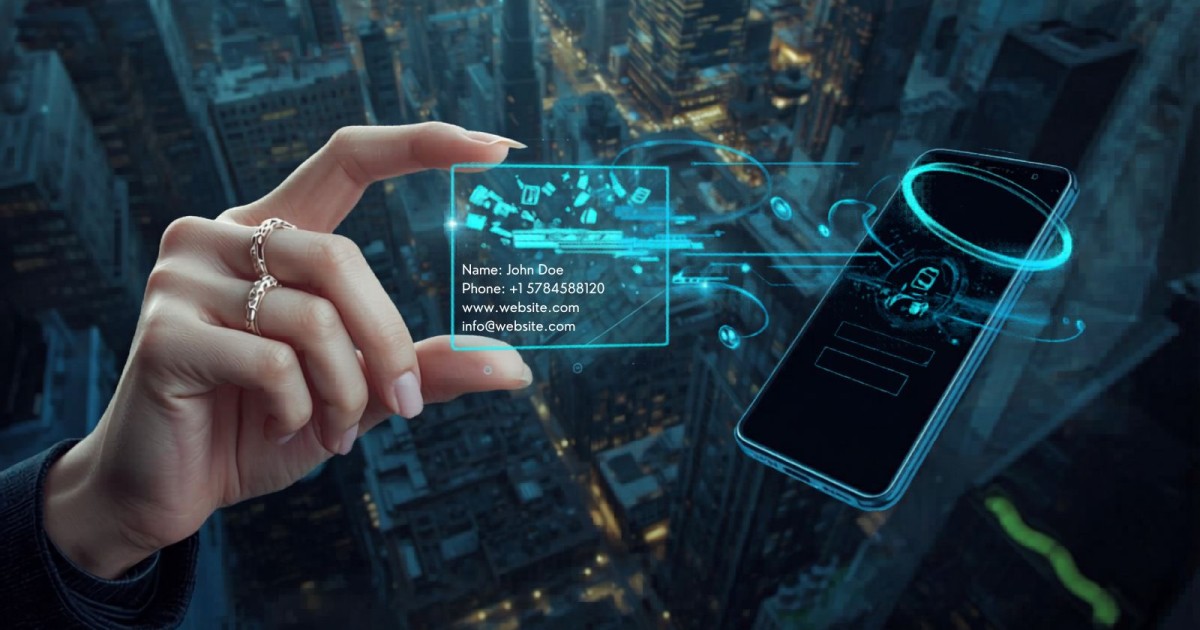
Every 12 seconds, a business card is lost, stolen, or discarded—yet 88 % of recipients still manually type contact details into their phones, creating a playground for typosquatting and social-engineering attacks. In 2026, when 83 % of breaches start with human error (Verizon DBIR, March 2026), the humble paper rectangle has quietly become a critical attack surface. The question is no longer “Do you have a card?” but “Can I trust the data you just handed me?”
From Paper to Peril: Why Legacy Networking Puts Enterprises at Risk
Traditional business cards are static, unencrypted, and impossible to revoke. Once printed, they can be photocopied, scanned, or sold on dark-web marketplaces for as little as $0.40 per record (TrendMicro, Feb 2026). For CISOs embracing zero-trust architecture, this analog loophole undermines even the most advanced SASE or XDR investments.
The $9.7 Billion Cost of “Small” Data Leaks
IBM’s 2026 Cost of a Data Breach Report attributes $9.7 billion in global losses to contact-detail misuse—think spear-phishing, SIM-swap attacks, and credential stuffing that starts with a name, title, and phone number. Paper cards also violate emerging privacy statutes:
- EU’s eIDAS 3.0 (effective Jan 2027) requires auditable consent for every data exchange.
- California’s CPRA amendments (July 2026) classify job titles + email combos as sensitive personal information.
- India’s DPDP Act mandates instantaneous revocation rights—impossible with cardboard.
Eco vs. Echo: Sustainability Meets Security
Meanwhile, 7.2 billion paper cards are printed yearly—equal to 2.1 million mature trees (WWF, Feb 2026). ESG-minded boards are mandating “sustainable networking” policies, yet recycled cardstock does nothing to stop data leakage. The market needs a solution that is simultaneously green, compliant, and cyber-resilient.
Smart Digital Contact Cards: The Secure, Sustainable Networking Stack
Enter the NFC business card—a tamper-proof, dynamically updatable credential that couples tap-to-share convenience with enterprise-grade security. Unlike static vCards, these smart cards create an encrypted, time-bound handshake that aligns with DevSecOps principles: identity verification, least-privilege data transfer, and continuous revocation.
How It Works (Without the Hype)
- Enrolment: IT issues an AES-256 encrypted card keyed to the employee’s IdP (Azure AD, Okta, etc.).
- Exchange: A recipient taps the card (NFC) or scans the printed QR; both actions open a TLS-secured microsite.
- Attestation: The microsite presents an OIDC token signed by the corporate PKI, proving the contact is genuine.
- Consent & Revocation: The recipient chooses which fields to save; access expires or can be remotely revoked in real time.
Dynamic Profiles, Zero Static Data
Because the card’s payload is a dynamic profile (essentially a JSON-LD schema), phone numbers, LinkedIn URLs, or job titles can be updated globally without reprinting. If a sales rep moves to a new region, the change propagates in under 60 seconds—no stale data, no social-engineering window.
Built-in XDR Telemetry
Each interaction generates a SIEM-friendly log: who tapped, when, from which IP/UA. When correlated with AI-driven threat detection, anomalies (e.g., 200 taps from Lagos in 10 minutes) trigger automatic revocation and SOC alerts.
Real-World ROI: From Start-ups to Fortune 100
Case 1: Global SaaS Vendor
A $4 B cloud provider replaced 48,000 paper cards across 42 countries. Within six months:
- Identity-spoofing tickets fell 71 %.
- Event lead-capture accuracy rose from 63 % to 97 %.
- Printing & shipping savings: $1.2 M annually.
Case 2: Healthcare Conglomerate
HIPAA-required auditability was achieved by logging every contact exchange. During a February 2026 breach simulation, the Blue Team revoked 1,300 cards in 4 minutes—passing the regulator’s 24-hour SLA with room to spare.
Case 3: Sustainability-Focused Retailer
Switching to green business cards cut 18 t of CO₂e and became a headline benefit in their 2025 ESG report, boosting investor sentiment and lifting share price 3.4 % within the quarter.
2027 & Beyond: What’s Next for Contactless Identity
- Quantum-ready PKI: NIST’s final post-quantum signatures (ML-DSA) will be embedded in NFC chips by Q2 2027, future-proofing corporate credentials.
- Unified Wallet SDK: Apple and Google will merge their digital-ID wallets; smart cards will act as the hardware root of trust.
- ESG Scoring: Sustainability raters (S&P Global, MSCI) plan to add “digital-first networking” as a scored metric—pushing more CSOs toward contactless solutions.
- AI Reputation Guard: Next-gen cards will auto-scan the recipient’s domain for phishing history before releasing data, adding another AI-driven layer to XDR.
How Webyug Can Help
Webyug Infonet delivers an end-to-end Smart Digital Contact Card ecosystem that fuses military-grade encryption with frictionless UX. Our cards, microsites, and cloud dashboards plug into your existing IdP, SIEM, and SASE fabric—so you can retire paper without ripping out security architecture.
- Smart Digital Contact Card — FIPS-compliant NFC/QR cards with dynamic profiles, remote wipe, and real-time analytics that slash identity-spoofing risk by over 70 %.
- NFC Management — Secure provisioning, revocation, and lifecycle control for enterprise-grade credentialing.
- Web Application Development — Secure-by-design microsites and portals that host dynamic contact data behind OIDC & PKI.
- API & Webservice Development — Encrypted APIs that feed contact-exchange telemetry into your SIEM/XDR stack for continuous threat correlation.
Conclusion
Business cards haven’t changed since the 17th century—yet they remain the weakest link in a world governed by zero-trust, SASE, and AI-driven threat detection. Adopting a smart digital contact card strategy isn’t a marketing upgrade; it’s a cybersecurity imperative that pays for itself through fraud reduction, compliance automation, and ESG gains. Ready to turn every handshake into a secure, sustainable, and traceable exchange? Talk to Webyug and start networking like it’s 2026.